Blog
Blog
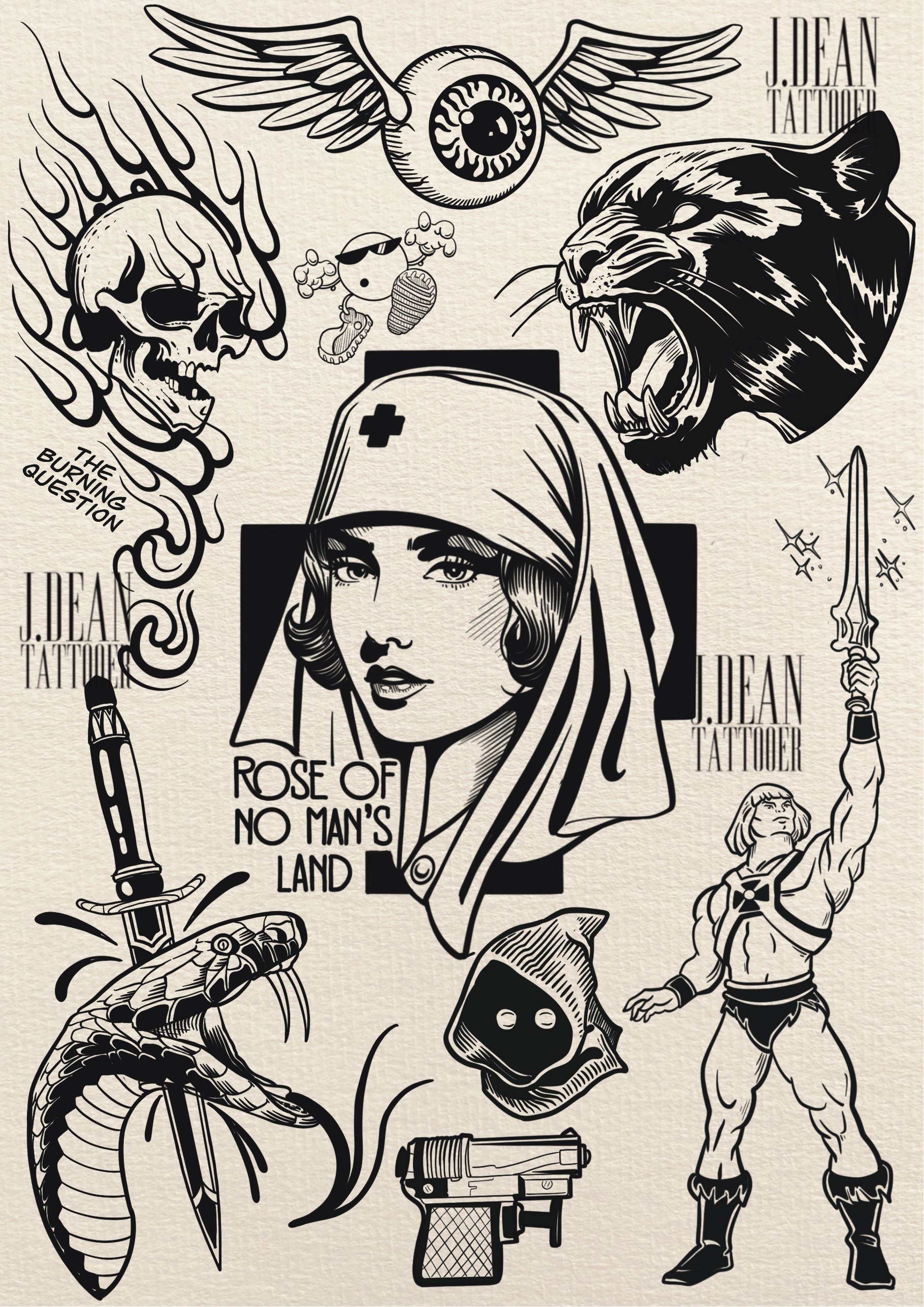
Flash Sheets and Flash Pieces: The Backbone of Tattoo Culture
22 April 2026Before Instagram, before custom consultations, before every tattoo was a hyper-personal “concept”—there was flash.
Flash sheets are the foundation of tattooing. They’re collections of pre-drawn designs, usually displayed on the walls of a shop, ready to be picked and tattooed. Simple, direct, no overthinking. You saw something you liked, you got it.
That’s how tattooing built itself.
Where Flash Came From
Flash as we know it really took shape in early 20th-century American tattoo shops. Artists like Sailor Jerry created bold, repeatable designs—eagles, daggers, roses, pin-ups—that could be tattooed quickly and consistently.
This wasn’t about originality in the modern sense. It was about:
Speed
Clarity
Longevity on skin
Designs had to read well from a distance and hold up over time. That’s why traditional flash is bold, high-contrast, and graphic.
And importantly—flash made tattooing accessible. You didn’t need to “design a tattoo.” You just chose one.
Flash vs Custom: What’s Actually Changed
These days, everything leans custom. People want something “no one else has.”
But here’s the reality:
Most tattoos are still built on existing visual language
Trends recycle constantly
And overcomplicated designs often age worse
Flash cuts through that.
It’s already resolved. Already tested. Already designed to work on skin.
And for a lot of people, it’s actually a better option:
Faster to book
More affordable
No back-and-forth designing
What you see is what you get
What Makes Good Flash
Good flash isn’t just random drawings on a page.
It’s about:
Strong composition
Clear silhouettes
Flow on the body
Simplicity without being boring
The best flash feels effortless—but it’s not. It’s distilled. Stripped back to what actually works.
James Dean’s Approach to Flash
Looking at James’ work, you can see he’s not treating flash as filler.
There’s a mix of influences running through it:
Traditional tattoo language (skulls, daggers, roses)
Pop and cult imagery (helmets, characters, iconography)
Fine-line illustrative elements
Blackwork textures and contrast
Some pieces lean classic. Others feel more illustrative or left-field. But they all sit within a tattoo-first mindset—they’re designed to go on skin, not just live on a page.
That’s the difference a lot of illustrators miss.
You can see it in the sheets:
Clean blackwork designs that will hold
Strong central figures (faces, animals, symbols)
Pieces that can stand alone or be built into larger compositions
There’s also a practical side to it. These are designs that don’t need over-explaining. You can walk in, point, and get tattooed.
Why Flash Still Matters
Flash hasn’t gone anywhere—it’s just been reframed.
Right now, it’s actually coming back strong because people are getting tired of:
Over-designed tattoos
Long wait times
Endless revisions
Flash brings it back to instinct.
You see it. You like it. You get it.
No performance around it.
Final Thought
Flash is where tattooing is at its most honest.
It’s not trying to be everything. It’s just trying to work.
And when it’s done well—like the kind James is putting out—it doesn’t feel like a compromise from custom work.
It feels like the point of tattooing in the first place.